
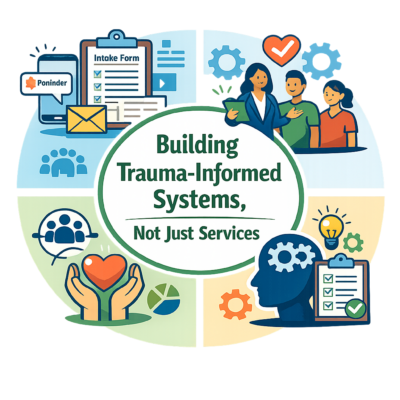
Building Trauma-Informed Systems, Not Just Services
Community Service Board of Middle Georgia
February 2026
Trauma-informed care has long been associated with clinical practice, but today its relevance extends far beyond the therapy room. As health and human service organizations modernize operations, expand digital communication, and rely on automated systems, trauma-informed principles must evolve as well. Increasingly, trauma-informed care is best understood not as a treatment model, but as an organizational operating philosophy.
In contemporary service environments, individuals often interact with systems long before they interact with clinicians. Appointment reminders, intake forms, surveys, automated check-ins, and internal workflows shape a person’s experience just as much as face-to-face services. When these systems fail to account for lived experience, they can unintentionally cause harm—even when no harm is intended.
Operational Decisions Carry Emotional Weight
Automation and artificial intelligence have improved efficiency across behavioral health and social service systems. However, efficiency without context can undermine trust. Communications generated without real-time awareness of a person’s circumstances may feel impersonal, intrusive, or distressing.
A trauma-informed organization recognizes that every operational touchpoint is a relational moment. This requires governance models that prioritize emotional safety, appropriate timing, and sensitivity—especially when systems depend on incomplete or delayed data. Trauma-informed operations ask leaders to examine not only whether processes are effective, but whether they are humane and respectful.
The Workforce Is the Foundation
One of the most significant shifts in trauma-informed thinking is the recognition that staff well-being is not secondary to service delivery—it is foundational to it. High-stress environments, reactive policies, and punitive management structures can unintentionally mirror the very dynamics trauma-informed care seeks to undo.
Organizations that successfully adopt trauma-informed cultures move away from framing burnout as an individual failure. Instead, they design systems that support emotional regulation, psychological safety, and shared accountability. When staff are supported through consistent leadership, clear expectations, and relational supervision, they are better equipped to engage compassionately and effectively with the people they serve.
Leadership Sets the Culture
Trauma-informed care cannot be sustained through policy statements alone. It requires leadership that models the values it promotes. Gaps between stated principles and executive behavior quickly erode credibility and stall progress.
Trauma-informed leadership means slowing down decision-making when needed, acknowledging stressors openly, and embedding relational awareness into supervision, communication, and performance expectations. It also means recognizing that culture is not static—without reinforcement, systems naturally revert to familiar patterns.
Culture Is Maintained, Not Achieved
A common misconception is that trauma-informed care reaches a point of completion. In reality, it is a living framework that requires continuous attention. Organizations that maintain trauma-informed cultures invest in ongoing training, shared language, internal champions, and routine reflection on practice.
Training across all roles—not only clinical staff—ensures that trauma-informed principles are consistently applied in daily interactions, documentation, and decision-making. This broad approach reinforces alignment and prevents fragmentation across departments.
A Strategic Imperative
For community-based providers like CSBMG, trauma-informed care is inseparable from organizational effectiveness. When embedded at the system level, it strengthens workforce stability, improves consumer experience, and reinforces trust across communities.
Ultimately, trauma-informed care is less about adopting a model and more about choosing a way of operating—one that acknowledges the realities people bring with them and responds with intention rather than reaction.
As behavioral health systems continue to evolve, organizations that treat trauma-informed care as culture—not compliance—will be best positioned to deliver care that is both effective and respectful.