
Substance Use Trends, Policy Shifts, and Emerging Evidence: January 2026 Update
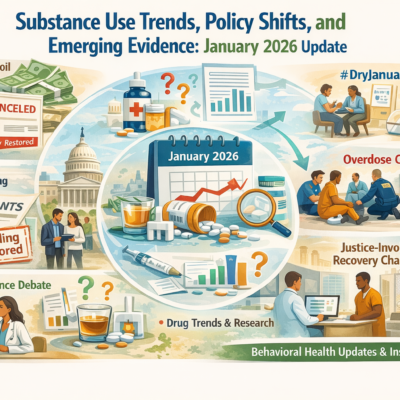
January 2026 reflected both instability and progress across the substance use prevention, treatment, and recovery landscape. From abrupt federal grant decisions to evolving research on addiction treatment, the month highlighted how quickly policy, science, and service delivery conditions can change—and why adaptability remains essential for providers and communities.
Federal Funding Uncertainty and System Stability
Mid-January brought widespread concern when the Substance Abuse and Mental Health Services Administration (SAMHSA) issued notices terminating certain federal grants, citing alignment with agency priorities. Early estimates indicated that nearly 2,800 grants totaling approximately $2 billion could be affected. Within 24 hours, however, the Department of Health and Human Services reversed the decision and rescinded the cancellations.
Although funding was ultimately restored, the episode underscored the fragility of the behavioral health funding environment and the potential downstream effects of abrupt policy actions on prevention, treatment continuity, workforce stability, and community trust (SAMHSA, 2026).
Reframing Prevention and Public Health Messaging
Public-facing conversations about alcohol use also gained attention in January. Addiction medicine leaders encouraged reframing initiatives such as “Dry January” as reflective experiments rather than punitive challenges. This approach emphasizes curiosity and self-awareness—inviting individuals to observe changes in sleep, mood, and wellbeing—rather than moralizing substance use behavior (Wakeman, 2026). Such framing aligns with trauma-informed and person-centered prevention strategies increasingly adopted in behavioral health systems.
Encouraging—but Cautious—Overdose Trends
The American Medical Association released its 2025 Report on Substance Use and Treatment, noting a decline in overdose deaths nationwide. Despite this positive trend, the report emphasized that the crisis remains complex due to increasing polysubstance use and volatility in the illicit drug supply. The AMA reiterated that expanded access to medications for opioid use disorder, naloxone, and evidence-based pain care has played a critical role in reducing mortality—and warned that regulatory and administrative barriers continue to delay lifesaving care (American Medical Association [AMA], 2025).
Conflicting Evidence on Alcohol and Health
Scientific debate resurfaced following a review published by the American Heart Association, which suggested that light alcohol consumption may pose no increased cardiovascular risk and could be protective. This conclusion was met with significant criticism from researchers citing newer population-level studies indicating that no amount of alcohol consumption is risk-free. The debate illustrates the challenges providers face when translating evolving—and sometimes conflicting—evidence into clear public health guidance (American Heart Association, 2026).
Policy Proposals and Concerns
Meanwhile, leadership transitions continued at SAMHSA, with the departure of Acting Director Art Kleinschmidt, PhD. Ongoing staffing and leadership changes add another layer of uncertainty at a time when consistency and clear federal direction are critically needed (SAMHSA, 2026).
Justice-Involved Populations and Continuity of Care
Innovative models addressing the intersection of substance use and incarceration also gained attention. A community clinic in Alaska demonstrated how linking justice-involved individuals to buprenorphine treatment, counseling, and reentry planning can significantly reduce overdose risk during the transition from incarceration back into the community. These efforts highlight the importance of cross-system coordination in addressing one of the most vulnerable periods for individuals with substance use disorders (National Council, 2026).
Shifting Federal Policy Landscape
At the federal level, substance use policy continues to evolve rapidly. An executive order signed by President Trump designated illicit fentanyl as a weapon of mass destruction, significantly expanding enforcement authority while acknowledging fentanyl’s legitimate medical use. At the same time, the Congressional Budget Office released an analysis of federal strategies to address the opioid crisis, examining supply reduction, demand reduction, and overdose prevention—along with the associated fiscal impacts of each approach (Congressional Budget Office [CBO], 2026).
Advancing Research and Persistent Barriers
January also brought important research developments. New studies continue to advance understanding of addiction treatment, including promising findings related to GLP-1 agonists, neuromodulation, and contingency management for stimulant use disorder. At the same time, research revealed persistent barriers—particularly for individuals prescribed buprenorphine, many of whom continue to face discrimination when seeking recovery housing despite federal protections (Addiction Policy Forum, 2026).
Emerging preclinical research on ibogaine further suggests potential mechanisms by which the substance may disrupt rigid behavioral patterns associated with addiction, though researchers cautioned that clinical applications remain uncertain and require rigorous evaluation.
Implications for Community-Based Providers
Together, these developments illustrate a behavioral health environment defined by rapid change, uneven progress, and ongoing tension between innovation and access. For community-based providers such as the Community Service Board of Middle Georgia (CSBMG), January’s trends reinforce the importance of:
- Stable and predictable funding streams
- Continued advocacy for evidence-based care
- Trauma-informed, person-centered messaging
- Cross-system coordination, particularly for justice-involved populations
- Vigilance in monitoring policy and regulatory shifts
As 2026 unfolds, the ability to adapt while remaining grounded in evidence and equity will remain central to advancing prevention, treatment, and recovery outcomes.
References
American Medical Association. (2025). 2025 report on substance use and treatment.
American Heart Association. (2026). Scientific review on alcohol consumption and cardiovascular health.
Congressional Budget Office. (2026). Federal policy approaches to address the opioid crisis.
Substance Abuse and Mental Health Services Administration. (2026). Federal grant administration updates.
Wakeman, S. (2026). Dry January as a curiosity-driven experiment. Harvard Gazette.
WBUR. (2026). Examining Italy’s San Patrignano and implications for U.S. addiction care.
Addiction Policy Forum. (2026). Recent breakthroughs in addiction research.
National Council for Mental Wellbeing. (2026). Justice-involved populations and continuity of care.