
The Housing Question: Medicaid, Health Outcomes, and the Future of Supportive Housing
Community Service Board of Middle Georgia (CSBMG)
February 2026
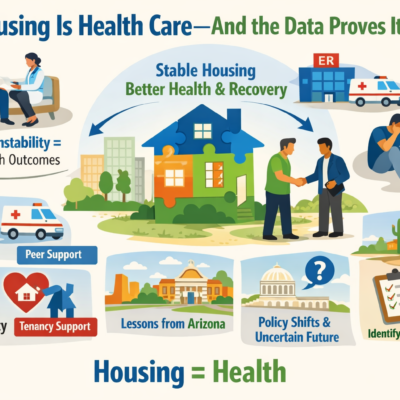
A substantial body of research has demonstrated the relationship between housing insecurity and increased health care utilization, poorer health outcomes, and higher public costs. Studies examining affordable housing, eviction, and homelessness consistently show that housing instability is associated with increased emergency department (ED) use, hospitalizations, and mortality, particularly among individuals with serious mental illness (SMI) and substance use disorder (SUD) (Oss, 2026).
Recent research titled Impact of Housing Support Services for Medicaid Enrollees with Serious Mental Illness, Substance Use Disorder extends this evidence base by quantifying the health and cost impacts of specific housing-related services. The study examined a Florida Medicaid pilot that provided four types of housing supports—transitional housing support, tenancy support, peer support, and crisis management—to high-need Medicaid enrollees with SMI or SUD (Oss, 2026).
Differential Impact of Housing Support Services
The findings revealed that not all housing-related services produce the same outcomes. Tenancy support and peer support emerged as particularly effective interventions. Peer support services were associated with a 20% reduction in ED utilization, while tenancy support services were linked to a 51% reduction in all-cause mortality. Researchers estimated that for every 15 individuals receiving tenancy support, one death was prevented, underscoring the life-saving potential of targeted housing interventions (Oss, 2026).
Conversely, some services were associated with increased health care utilization. Transitional housing support was linked to a 15% increase in ED visits, while crisis management services were associated with higher ED use, outpatient visits, and psychiatric hospitalizations. The authors attributed these increases to the identification of previously unmet needs during housing transitions and the stabilization of individuals experiencing acute crises. Rather than indicating inefficiency, these findings suggest that crisis-oriented services may temporarily increase utilization as part of addressing long-standing gaps in care (Oss, 2026).
The researchers concluded that Medicaid policy should prioritize high-value, data-driven housing interventions and embed them within managed care contracts to ensure sustainability. However, recent federal policy shifts regarding coverage of health-related social needs have introduced uncertainty about the long-term viability of these approaches (Oss, 2026).
Arizona’s Longstanding Housing and Health Model
Arizona offers a notable example of integrating housing supports into Medicaid. Through the Arizona Health Care Cost Containment System (AHCCCS), the state has provided health-related housing services since 2014. Using a Housing First model, the AHCCCS Housing Program (AHP) delivers permanent supportive housing through partnerships with behavioral health providers and community landlords. Participants contribute up to 30% of their income toward rent, with the remaining costs subsidized through the program. AHP funding also covers deposits, move-in assistance, eviction prevention, and wraparound support services (Oss, 2026).
Among the 2,472 members enrolled in AHP as of 2020, AHCCCS reported a 30% reduction in ED visits, a 44% decrease in inpatient admissions, and average cost savings of $5,563 per member per month. Despite these outcomes, approximately 30,000 AHCCCS members were still identified as homeless, the majority with SUD-related encounters and average annual costs of $23,000 per person (Oss, 2026).
To address this gap, AHCCCS obtained an 1115 Medicaid waiver to establish the Housing and Health Opportunities (H2O) Program. Administered by Solari and Banner Health Plans, the H2O demonstration runs through November 2027 and provides transitional housing supports for individuals who are homeless or at risk of homelessness and who have SMI with additional medical or justice-system involvement. Services include short-term housing, move-in costs, medically necessary home modifications, and continued housing supports for up to 18 months following permanent placement (Oss, 2026).
Policy Uncertainty and the Path Forward
While early outcomes from programs such as AHP and H2O suggest meaningful improvements in health outcomes and cost containment, the future of Medicaid-funded housing supports remains uncertain. Recent announcements from the Centers for Medicare & Medicaid Services (CMS) indicate a shift away from funding services that address health-related social needs. In addition, policy proposals suggest reduced federal support for Housing First models, raising concerns about the sustainability of evidence-based housing interventions (Oss, 2026).
In this evolving policy environment, Medicaid agencies, managed care organizations, and provider networks will need to identify alternative pathways to support housing stability for high-need populations. The evidence remains clear: housing is a critical determinant of health, and well-designed housing supports can reduce emergency utilization, improve care continuity, and support long-term recovery. The challenge ahead lies not in proving the value of housing as health care, but in sustaining these interventions amid shifting policy priorities.
Reference
Oss, M. E. (2026, February 5). The housing question. OPEN MINDS.