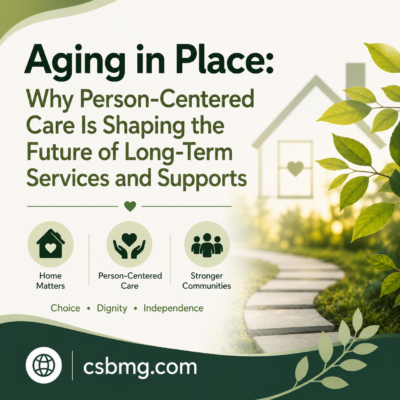
Aging in Place: Why Person-Centered Care Is Shaping the Future of Long-Term Services and Supports
Community Service Board of Middle Georgia
For many older adults and individuals living with disabilities, home represents more than a place to live—it represents independence, dignity, familiarity, and connection to community. As healthcare continues to evolve, one message has become increasingly clear: people want services that allow them to remain safely in their homes and communities for as long as possible. This growing preference is reshaping how long-term services and supports (LTSS) are designed, delivered, and evaluated (OPEN MINDS, 2026).
Behavioral health organizations, healthcare providers, and community partners are increasingly recognizing that successful care extends beyond treating medical conditions. It involves understanding each person’s goals, supporting meaningful community participation, and coordinating services that promote overall well-being.
The Growing Preference for Aging in Place
Research consistently demonstrates that older adults overwhelmingly prefer to remain in their own homes when they begin needing additional support. According to OPEN MINDS (2026), more than nine out of ten older adults currently live independently, and most would choose to remain there if assistance becomes necessary. Similarly, many individuals with disabilities express a strong preference for independent living when appropriate services and supports are available.
This shift reflects a broader movement toward consumer-centered healthcare, where individuals have greater input into how and where they receive services. Rather than focusing solely on institutional care, providers are increasingly expanding home- and community-based services that promote independence while maintaining safety and quality of care.
Whole-Person Care Improves Outcomes
Person-centered care has become a guiding principle across healthcare and behavioral health. Instead of treating isolated conditions or focusing on individual services, whole-person care considers the physical, behavioral, emotional, and social factors that influence health.
This approach asks important questions beyond clinical treatment:
- Does the individual have reliable transportation?
- Are behavioral health needs being addressed alongside physical health?
- Does the person have meaningful social connections?
- Can they safely remain in their home and community?
- Are services coordinated in a way that supports their personal goals?
When healthcare providers, behavioral health professionals, family members, and community organizations work together, individuals are often better positioned to experience improved health outcomes and greater quality of life (OPEN MINDS, 2026).
Measuring Success Beyond Compliance
Healthcare has traditionally emphasized regulatory compliance and documentation. While these remain important components of quality care, the industry is increasingly shifting toward measuring meaningful outcomes.
Rather than asking only whether required services were delivered, organizations are beginning to evaluate questions such as:
- Are individuals experiencing fewer preventable hospitalizations?
- Are fall risks being identified early?
- Are people able to remain safely in their homes longer?
- Do individuals report improved quality of life?
- Are they actively participating in their communities?
These outcome measures provide a more complete picture of whether services are making a meaningful difference in people’s daily lives (OPEN MINDS, 2026).
The Importance of Data
Data has become an essential tool for improving healthcare quality. Reliable outcome measures help organizations identify service gaps, evaluate program effectiveness, and make informed decisions that improve care.
For behavioral health organizations, data can help answer critical questions such as:
- Which services produce the strongest outcomes?
- Where are barriers preventing individuals from accessing care?
- Which interventions reduce avoidable hospitalizations?
- How can resources be better aligned with community needs?
Using data alongside clinical expertise allows organizations to continuously improve services while demonstrating value to individuals, families, communities, and funding partners.
Community-Based Care Creates Stronger Communities
Community Service Board of Middle Georgia recognizes that recovery, wellness, and independence are strengthened through community connection. Whether supporting individuals living with serious mental illness, substance use disorders, intellectual and developmental disabilities, or co-occurring conditions, community-based services help people remain connected to the people and places that matter most.
Services that promote independence often lead to improved confidence, stronger support systems, greater community engagement, and enhanced overall well-being. They also reflect the belief that individuals should have opportunities to live, work, recover, and thrive within their own communities whenever possible.
Looking Ahead
The future of long-term services and supports continues to move toward personalized, outcome-driven care that prioritizes independence, collaboration, and quality of life. As healthcare systems evolve, success will increasingly be measured not only by the services provided but by the lives improved.
By embracing person-centered care, strengthening community partnerships, and focusing on meaningful outcomes, organizations can help ensure that individuals receive the right care, at the right time, in the right place—while maintaining the dignity and independence they value most.
References
OPEN MINDS. (2026). LTSS: From compliance to consumerism. OPEN MINDS Market Intelligence Service.
OPEN MINDS. (2026). Most older adults who live at home want to age in place, but they aren’t entirely confident they’ll get to. OPEN MINDS Industry Library.