
Bots Should Handle Volume, Humans Should Handle Reality: Why Human Connection Still Matters In Behavioral Health
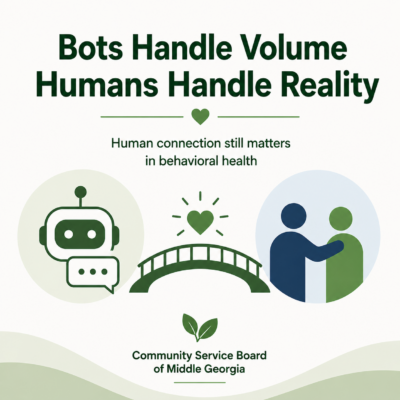
Community Service Board of Middle Georgia (CSBMG)
Introduction
As artificial intelligence (AI) continues to transform how organizations deliver customer service, efficiency gains are becoming easier to achieve. AI-enabled chatbots can quickly handle high-volume, repetitive tasks such as scheduling, account updates, and basic information requests. However, as Monica E. Oss (2026) highlights, efficiency should not come at the expense of trust, empathy, and meaningful human connection—especially in health care and behavioral health settings.
At the Community Service Board of Middle Georgia (CSBMG), we recognize that technology should strengthen service delivery, not replace the compassionate relationships that are foundational to recovery, crisis response, and long-term wellness. In behavioral health, moments of uncertainty, fear, and emotional distress require more than automation; they require people who can listen, understand, and respond with clinical judgment and care.
The Appropriate Role of AI in Consumer Experience
AI performs exceptionally well in predictable, rules-based interactions. These may include appointment reminders, location information, service hours, basic referral steps, and documentation support. When used strategically, AI can reduce administrative burden and allow staff to dedicate more time to direct service engagement (Oss, 2026) .
For organizations like CSBMG, this creates opportunities to improve access while preserving high-quality care. For example, AI may assist with:
- Frequently asked questions about clinic hours and services
- Appointment scheduling support
- Automated follow-up reminders
- Resource navigation for basic community needs
- Documentation and note support for staff workflows
These uses improve operational efficiency and can reduce delays for individuals seeking support.
Why Human Support Must Remain Central
While AI can manage volume, it cannot replace the trust-building that happens through human interaction. Behavioral health services are deeply personal and often involve crisis, trauma, grief, substance use recovery, housing instability, or family stressors. These conversations require empathy, cultural awareness, and nuanced decision-making. Oss (2026) emphasizes that when organizations remove human access entirely, they risk weakening consumer relationships and eroding trust .
For CSBMG, this distinction is especially important across crisis stabilization, outpatient counseling, peer recovery, co-responder services, and youth behavioral health programming. Individuals in distress may need reassurance, de-escalation, clarification, or immediate escalation to clinical staff—needs that should never be left solely to automated systems.
Human professionals remain essential for:
- Crisis intervention and de-escalation
- Safety and risk assessment
- Escalation and exception handling
- Emotional reassurance and service recovery
- Supporting families during high-stress moments
- Rebuilding trust after negative care experiences
Implications for Behavioral Health Leadership
The growing use of AI in health-related settings challenges leaders to be intentional in designing the consumer journey. The goal should not be to automate everything, but to thoughtfully determine where automation improves access and where human connection must remain the priority (Oss, 2026) .
At CSBMG, innovation should always align with our mission of improving lives through compassionate, community-based behavioral health care. Technology can support that mission when it removes barriers, streamlines access, and empowers staff. However, trust, dignity, and person-centered care must continue to guide every service touchpoint.
Conclusion
AI should enhance the middle of the service journey—not replace the beginning or the most critical human moments. In behavioral health, people often reach out during vulnerable times, and the quality of that first interaction can shape whether they remain engaged in care. CSBMG values innovation, but we also understand that healing happens through relationships.
As AI tools continue to evolve, the strongest organizations will be those that use technology to reduce routine burden while preserving the empathy, trust, and human responsiveness that define excellent care (Oss, 2026) .
Reference
Oss, M. E. (2026, April 13). Bots should handle volume, humans should handle reality. OPEN MINDS.