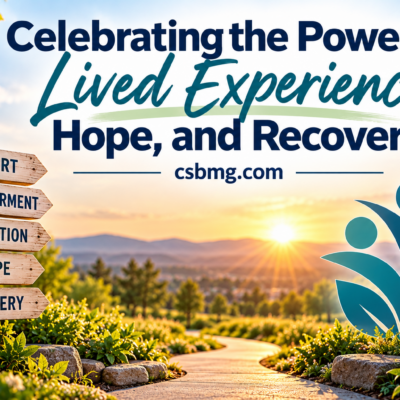
Celebrating the Power of Lived Experience, Hope, and Recovery
October 26, 2026 | Community Service Board of Middle Georgia (CSBMG)
Every year on October 15, Global Peer Support Celebration Day recognizes individuals who transform their lived experiences into powerful sources of hope, encouragement, and healing for others. At the Community Service Board of Middle Georgia (CSBMG), this occasion provides an opportunity to celebrate the invaluable contributions of peer support professionals who help individuals and families navigate mental health challenges, substance use recovery, and the journey toward greater independence and well-being.
Peer support is grounded in a simple yet profound principle- individuals who have experienced challenges firsthand possess unique insight and understanding that can help others navigate similar circumstances. Through shared experiences, mutual respect, and meaningful connections, peer support professionals demonstrate that recovery is possible and that no one must face life’s challenges alone.
Understanding the Importance of Peer Support
Peer support is an essential component of recovery-oriented behavioral health services. Unlike traditional clinical relationships, peer support emphasizes mutual understanding, shared experiences, empowerment, and personal choice. Peer support professionals draw upon their own recovery journeys to establish trust, offer encouragement, and help individuals recognize their strengths and potential.
According to the Substance Abuse and Mental Health Services Administration (SAMHSA, 2023), peer support workers use their lived experiences of recovery to engage individuals in treatment, promote recovery, and support people in developing meaningful lives within their communities.
Research also suggests that peer-delivered services can positively influence recovery-related outcomes, including hope, empowerment, and personal recovery (Chinman et al., 2014).
These findings reinforce the importance of recognizing peer support as more than an additional service. It is a meaningful approach to helping individuals feel heard, respected, and empowered throughout their recovery journeys.
The Role of Peer Support at CSBMG
At CSBMG, the principles of peer support align with the agency’s commitment to providing person-centered, recovery-oriented behavioral health services to individuals and families throughout Middle Georgia.
Peer support professionals contribute to this mission by helping individuals build confidence, strengthen their self-advocacy skills, identify community resources, and establish meaningful recovery goals.
Their contributions extend beyond sharing personal experiences. Peer support professionals help bridge the gap between individuals receiving services and the broader systems of care by providing encouragement and practical guidance grounded in firsthand understanding.
Through these relationships, peer support professionals can help individuals:
- Develop hope and confidence in their ability to achieve recovery goals
- Reduce feelings of isolation and stigma associated with mental health and substance use challenges
- Strengthen self-advocacy and decision-making skills
- Identify community resources and build supportive relationships
- Celebrate personal achievements and recognize progress toward greater independence
The value of these connections is supported by research identifying peer support as an important contributor to recovery-oriented mental health care (Repper & Carter, 2011).
Supporting Youth, Families, and Communities
Peer support is particularly meaningful when working with young people and families navigating behavioral health challenges.
Georgia Parent Support Network (GPSN) emphasizes the importance of lived experience through its Certified Peer Specialist–Parent (CPS-P) and Certified Peer Specialist–Youth (CPS-Y) programs. These initiatives recognize that parents, caregivers, and young adults who have navigated behavioral health systems can offer valuable guidance and encouragement to others facing similar experiences.
For families, connecting with someone who understands the challenges of advocating for a child can provide reassurance, practical knowledge, and a renewed sense of hope. For young people, relationships with peers who have navigated their own behavioral health journeys can encourage self-expression, resilience, and confidence.
These approaches reflect the broader principles of peer support described by SAMHSA (2023), including mutuality, respect, shared responsibility, and empowerment.
Recognizing the People Behind the Purpose
Recognizing peers is an opportunity to highlight the dedication, compassion, and resilience of individuals who have chosen to use their personal experiences in service to others.
Behind every peer support relationship is a story of perseverance. Many peer support professionals have experienced significant challenges in their own lives, yet they have transformed those experiences into opportunities to inspire and uplift others.
Their work reminds us that recovery does not always follow a straight path. Progress may come through small victories, difficult conversations, renewed confidence, or the simple realization that someone genuinely understands.
At CSBMG, we recognize that these moments of connection can have a lasting impact on the individuals and families we serve.
Celebrating Hope, Connection, and Recovery
CSBMG extends its appreciation to peer support professionals throughout our agency, across Georgia, and around the world.
Your willingness to share your experiences, advocate for others, and demonstrate the possibilities of recovery contributes to stronger individuals, families, and communities.
We celebrate not only the work you do but also the hope you represent.
When individuals use their lived experiences to lift others, they remind us that recovery is possible, every voice matters, and no journey must be traveled alone.
References
Chinman, M., George, P., Dougherty, R. H., Daniels, A. S., Ghose, S. S., Swift, A., & Delphin-Rittmon, M. E. (2014). Peer support services for individuals with serious mental illnesses: Assessing the evidence. Psychiatric Services, 65(4), 429–441. https://doi.org/10.1176/appi.ps.201300244
Repper, J., & Carter, T. (2011). A review of the literature on peer support in mental health services. Journal of Mental Health, 20(4), 392–411. https://doi.org/10.3109/09638237.2011.583947
Substance Abuse and Mental Health Services Administration. (2026). Peer support workers for those in recovery. https://www.samhsa.gov/substance-use/recovery/peer-support-workers