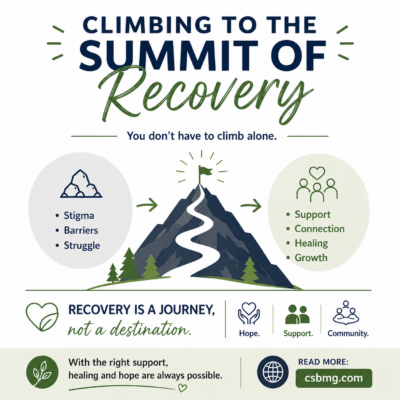
Climbing to the Summit of Recovery: Traversing Roadblocks on the Recovery Journey
Community Service Board of Middle Georgia (CSBMG)
Introduction
Recovery is often described as a journey, but for many individuals and families, it can feel more like climbing a mountain. The path may include emotional pain, stigma, limited access to care, cultural barriers, fractured relationships, and the daily work of rebuilding hope. Even so, recovery remains possible. The Substance Abuse and Mental Health Services Administration (SAMHSA) defines recovery as a process of change through which individuals improve their health and wellness, live self-directed lives, and strive to reach their full potential (SAMHSA, 2012). That definition reminds us that recovery is not simply about stopping substance use. It is about healing the whole person.
For CSBMG, this whole-person perspective matters deeply. Recovery is strengthened when people are supported not only clinically, but also emotionally, socially, spiritually, and culturally. When individuals are seen, respected, and connected to meaningful support, the climb becomes more manageable.
The Obstacles of Recovery
Many people in recovery face barriers that extend far beyond substance use itself. These barriers may include shame, trauma, unstable housing, family conflict, financial strain, lack of transportation, and difficulty accessing treatment and recovery support services. In many communities, especially rural ones, recovery can be further complicated by workforce shortages and limited behavioral health resources (SAMHSA, 2025). These realities can make it harder for individuals to stay engaged in care and maintain hope during difficult seasons.
Recovery can also be slowed by stigma and misunderstanding. When addiction is treated as a moral failing rather than a health condition, people may delay seeking help or feel isolated in their healing process. Hazelden Betty Ford notes that public stigma and discrimination have long affected how addiction is viewed and how people in recovery are treated in systems such as housing, employment, and healthcare (Hazelden Betty Ford Foundation, n.d.-a). Reducing stigma is essential because people recover more effectively in environments where dignity, compassion, and encouragement are present.
SAMHSA (2012) also emphasizes that recovery is built on several guiding principles, including hope, person-driven care, multiple pathways, peer support, relational connection, culture, and respect. These principles are especially important when the road feels steep. They remind us that setbacks do not erase progress and that support from others can make a life-changing difference.
The Role of Connection in Healing
No one should have to climb the mountain of recovery alone. Supportive relationships often serve as anchors during difficult moments. Peer support, family support, faith communities, treatment teams, and trusted mentors can all help individuals remain grounded in recovery. SAMHSA identifies peer support and relationships as core components of the recovery process, recognizing that mutual support and shared understanding promote resilience and healing (SAMHSA, 2012).
Hazelden Betty Ford also highlights the value of ongoing recovery support and coaching, noting that structure, accountability, encouragement, and healthy routines can help individuals maintain progress over time (Hazelden Betty Ford Foundation, n.d.-b). This is a valuable reminder for communities like those served by CSBMG. Recovery does not end when treatment ends. It continues through daily choices, supportive relationships, and community systems that make sustained healing possible.
The Art of Making Amends
One of the most meaningful aspects of recovery is the opportunity to repair what addiction may have damaged. Making amends is more than apologizing. It involves accountability, honest reflection, changed behavior, and a willingness to rebuild trust through consistent action. Hazelden Betty Ford explains that making amends can reduce shame, ease guilt, and strengthen recovery by helping individuals align their present actions with their values (Hazelden Betty Ford Foundation, 2025).
This process is not always easy. It requires humility, courage, and patience. Some relationships may heal quickly, while others may take longer. In some cases, direct amends may not be appropriate or possible, and change must instead be demonstrated through healthier living and continued personal growth. Even so, the process of making amends can be deeply healing because it helps individuals move from regret toward responsibility.
For people in recovery, amends can also be internal. Healing may require learning to forgive oneself, release toxic shame, and accept that personal worth is not erased by past mistakes. Recovery invites people to believe that they are still deserving of love, dignity, and belonging.
Recovery and Self-Discovery
Recovery is not only about what a person leaves behind. It is also about what a person discovers within. Many individuals enter recovery carrying beliefs that they are unworthy, broken, or beyond help. Over time, healing can challenge those beliefs and open the door to self-respect, identity, and renewed purpose.
That journey of self-discovery is often central to long-term wellness. SAMHSA’s recovery framework emphasizes self-direction, empowerment, and strengths-based growth, all of which support individuals in building lives that reflect meaning and possibility rather than shame and survival alone (SAMHSA, 2012). Recovery helps people reconnect with their values, rediscover their voice, and develop a fuller understanding of who they are beyond addiction.
For CSBMG, this message is especially important. The journey of recovery should not be measured only by abstinence or symptom reduction, but also by improved quality of life, stronger relationships, increased hope, and a growing sense of purpose. True healing involves mind, body, and spirit.
Why Whole-Person Recovery Matters
Whole-person recovery recognizes that every individual brings unique experiences, needs, culture, strengths, and challenges to the healing process. SAMHSA (2012) notes that recovery is holistic and culturally influenced, meaning that services should honor the full context of a person’s life. This includes emotional wellness, physical health, trauma history, family relationships, spirituality, and community connection.
That perspective aligns with the mission of CSBMG. Behavioral health support is strongest when it is compassionate, person-centered, and responsive to the realities people face every day. Communities benefit when recovery systems create space for multiple pathways, honor lived experience, and reduce barriers that keep people from accessing care.
Conclusion
Recovery can feel like a mountain climb, but it is a climb that no one has to make alone. Obstacles such as stigma, limited resources, emotional pain, and broken trust are real, yet they do not have to define the outcome. With support, accountability, connection, and hope, recovery can become a journey of healing and transformation.
At CSBMG, we believe recovery is possible for every person. By embracing whole-person care, encouraging meaningful relationships, and recognizing the courage it takes to keep moving forward, we help create communities where healing is not only talked about, but truly supported. Each step matters, and every step forward is worth honoring.
References
Hazelden Betty Ford Foundation. (n.d.-a). Smashing the stigma of addiction.
Hazelden Betty Ford Foundation. (n.d.-b). Sober and recovery coaching and monitoring: Find a coach.
Hazelden Betty Ford Foundation. (2025, October 9). Making amends in addiction recovery.
Substance Abuse and Mental Health Services Administration. (2012). SAMHSA’s working definition of recovery.
Substance Abuse and Mental Health Services Administration. (2025). Peer recovery supports for behavioral health in rural communities.