
Managing Academic Stress: Support Starts Here
Community Service Board of Middle Georgia (CSBMG)
Introduction
April’s Stress Awareness Month serves as an important reminder that academic pressure can significantly affect the mental health and emotional well-being of students. From deadlines and exams to balancing work, family, and personal expectations, academic stress can quickly become overwhelming. At CSBMG, we recognize that students, families, and support systems all play a critical role in promoting resilience and wellness.
Recent guidance from The Steve Fund emphasizes that intentional, small steps can make a meaningful difference in helping students remain grounded and emotionally supported during high-pressure moments
Understanding Academic Stress
Academic stress is more than simply feeling busy. Prolonged stress can contribute to burnout, difficulty concentrating, sleep disruption, anxiety, and emotional exhaustion. Students may feel pressure to perform academically while also managing financial concerns, social expectations, and uncertainty about the future.
According to Primm (2026), establishing routines, improving time management, and building supportive relationships are foundational tools for managing academic stress effectively
Strategies for Students
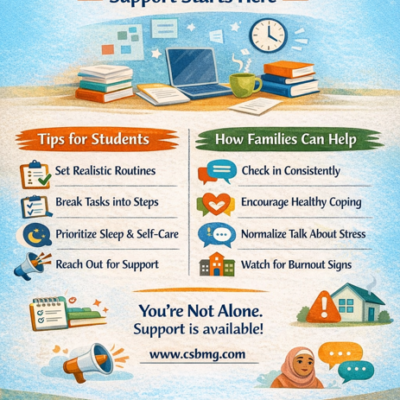
Students can strengthen their well-being through:
- Creating realistic daily and weekly routines
- Breaking large assignments into smaller tasks
- Prioritizing sleep and nutrition
- Scheduling regular mental health breaks
- Reaching out to trusted faculty, counselors, or mentors
- Practicing mindfulness and grounding exercises
At CSBMG, we encourage students to remember that asking for support is a sign of strength, not weakness.
How Families and Support Systems Can Help
Families, educators, and mentors can support students by:
- Checking in consistently without judgment
- Encouraging healthy coping skills
- Normalizing conversations about stress
- Helping students identify school campus, faith-based, and community mental health resources
- Watching for signs of burnout or emotional withdrawal
Strong support networks can reduce isolation and improve resilience during stressful academic periods.
Conclusion
Stress may be common in academic settings, but students do not have to face it alone. With intentional support, healthy routines, and early intervention, young people can thrive even in demanding seasons. CSBMG remains committed to promoting mental wellness, emotional resilience, and recovery-focused care for youth and young adults across Middle Georgia.
References
Primm, A. B. (2026). Managing academic stress. The Steve Fund. https://stevefund.org/