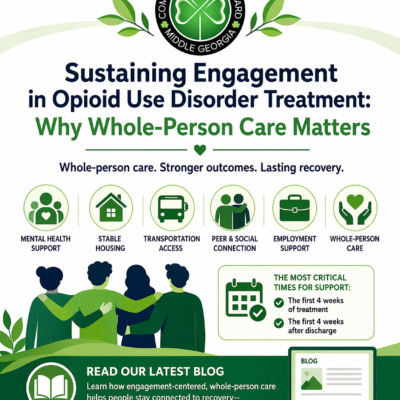
Sustaining Engagement in Opioid Use Disorder Treatment: Why Whole-Person Care Matters
Community Service Board of Middle Georgia (CSBMG)
Introduction
Sustained engagement remains one of the most important predictors of successful outcomes in opioid use disorder (OUD) treatment. Recent findings highlighted by Monica E. Oss (2026) emphasize a clear connection between medication adherence and lower overall healthcare costs, reduced hospital utilization, and fewer detoxification episodes. For behavioral health organizations like CSBMG, these findings reinforce the importance of designing treatment systems that prioritize continuity, flexibility, and person-centered recovery supports.
As communities across Georgia continue addressing opioid-related challenges, the conversation must move beyond treatment initiation alone and focus on what helps individuals stay engaged in recovery over time.
The Cost of Disengagement
The research reviewed by Oss (2026) found that only 24.7% of insured individuals receiving extended-release buprenorphine remained adherent to the recommended treatment regimen. Those who remained engaged experienced significantly lower annual healthcare costs compared to those who disengaged from care.
More importantly, the steepest treatment drop-offs consistently occur during two vulnerable periods:
- the first four weeks after treatment begins
- the first four weeks after discharge from structured care settings
These transition points are critical because they often coincide with reduced structure, increased stress, and barriers such as transportation, housing instability, and limited support systems.
For provider organizations, this highlights a central truth: disengagement is often not a lack of motivation, but a mismatch between service design and real-world recovery journeys.
Recovery Is Not Linear
One of the most powerful takeaways from the article is the reminder that opioid recovery rarely follows a predictable, step-by-step progression. Oss (2026) notes that traditional addiction treatment models often rely on fixed levels of care that assume individuals will move neatly from one stage to the next.
However, real-life recovery is dynamic. Individuals may experience setbacks, changes in motivation, co-occurring mental health symptoms, family stressors, or social determinants of health that require adjustments in treatment intensity and support.
At CSBMG, this aligns closely with our commitment to meeting people where they are, recognizing that recovery pathways should be flexible, trauma-informed, and responsive to changing needs.
The Whole-Person Model Improves Retention
A key theme in the research is that medication alone is not enough to sustain long-term engagement. Consumers are more likely to remain in care when treatment programs also address:
- co-occurring mental health conditions
- stable housing needs
- transportation barriers
- family and social support
- employment and life stability needs
This whole-person framework reflects the integrated care approach CSBMG champions across its crisis, outpatient, recovery, and community-based programs.
By addressing both clinical and practical barriers, organizations can reduce preventable treatment drop-off and improve both health outcomes and long-term recovery success.
Why Transitions Matter Most
The article places special emphasis on discharge planning as the highest-risk transition point in the treatment continuum. Oss (2026) notes that failure to offer medication for opioid use disorder (MOUD) at discharge places individuals at significantly increased risk.
For CSBMG and community partners, this reinforces the importance of:
- warm handoffs between providers
- coordinated discharge planning
- rapid outpatient follow-up
- peer support connection
- transportation and access solutions
- linkage to housing and community resources
Strong transitions are often where recovery is either strengthened or interrupted.
Conclusion
The future of opioid use disorder treatment depends on more than clinical services alone—it depends on engagement-centered systems of care. As Oss (2026) highlights, the organizations that achieve the best outcomes are those that build flexible care continuums and address the full realities of a person’s life.
At CSBMG, we believe recovery thrives when treatment models honor the whole person, strengthen support during transitions, and remove barriers that make it harder to stay connected. Whole-person, community-based care is not simply a best practice—it is essential to hope, wellness, and sustained recovery.
Reference
Oss, M. E. (2026, April 9). It’s the engagement. OPEN MINDS.