
The 3-3-3 Rule: A Simple Grounding Technique for Moments of Anxiety
Community Service Board of Middle Georgia
Anxiety can sometimes make it difficult to focus on what is happening in the present moment. Thoughts may begin racing, worries can feel overwhelming, and physical symptoms such as muscle tension, restlessness, or a rapid heartbeat may occur. Although occasional anxiety is a normal part of life, persistent anxiety that interferes with work, school, relationships, or daily activities may be a sign that additional support is needed (National Institute of Mental Health [NIMH], n.d.-a).
One simple strategy that may help during moments of stress or anxiety is the 3-3-3 Rule. This grounding technique encourages a person to intentionally focus on their immediate surroundings instead of becoming consumed by anxious thoughts.
Grounding techniques use attention, movement, and the senses to reconnect a person with the present moment. By directing attention toward what can be seen, heard, or physically experienced, grounding can provide a temporary way to interrupt overwhelming thoughts and refocus attention (Cleveland Clinic, 2024).
What Is the 3-3-3 Rule?
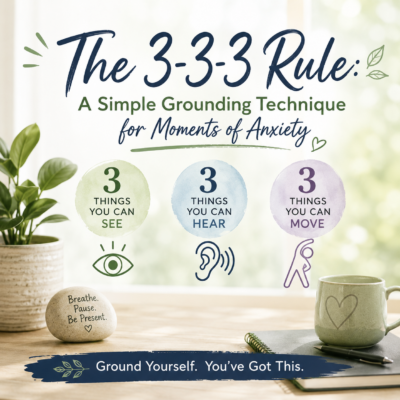
The 3-3-3 Rule is easy to remember:
See three things. Hear three things. Move three things.
When anxiety begins to build, pause and intentionally notice what is happening around you. The goal is not necessarily to make anxiety disappear. Instead, the exercise gives your mind something concrete and immediate to focus on.
The Cleveland Clinic (2024) identifies the 3-3-3 technique as a sensory grounding strategy that can help individuals focus on their surroundings and become more present. Similarly, mindfulness practices emphasize bringing attention back to what is happening in the present rather than remaining focused on worries about the past or future (NIMH, n.d.-b).
How to Practice the 3-3-3 Rule
- See Three Things
Look around and identify three objects you can see. Instead of simply naming each object, take a moment to notice its details.
You might notice:
- The color of a chair
- The shape of a window
- The texture or pattern on a wall
Paying closer attention to ordinary objects can help redirect your focus toward your immediate environment.
- Hear Three Things
Next, listen carefully and identify three different sounds.
You might hear:
- A fan or air conditioner
- Cars passing outside
- People talking nearby
Try to focus on each sound individually. Connecting with sensory information such as sight and sound can help bring awareness back to the here and now (Cleveland Clinic, 2024).
- Move Three Parts of Your Body
Finally, intentionally move three different parts of your body.
For example:
- Wiggle your fingers
- Roll your shoulders
- Move your ankles or tap your toes
Movement provides another physical point of focus and can help reconnect attention with your body and surroundings.
Why Grounding May Help During Anxiety
When people become anxious, their attention can become centered on worries, fears, or “what if” thoughts. Grounding provides an opportunity to redirect attention toward information that is happening right now.
The U.S. Department of Veterans Affairs describes grounding as a strategy for shifting attention toward the present and external environment rather than becoming absorbed in distressing internal experiences (U.S. Department of Veterans Affairs, 2024).
Grounding exercises may help by:
- Redirecting attention: Focusing on specific sights, sounds, and movements gives the mind an immediate task
- Encouraging present-moment awareness: Sensory information helps reconnect attention with what is happening right now
- Providing a portable coping strategy: The technique requires no equipment and can be practiced in many settings
- Creating a brief pause: Taking a moment to observe your surroundings may help you respond more intentionally when emotions feel overwhelming
A Tool You Can Take Almost Anywhere
One advantage of the 3-3-3 Rule is its simplicity. It can be practiced quietly at home, at work, at school, in a waiting room, or in many other everyday settings.
For example, someone experiencing anxiety before a meeting might identify three objects in the room, listen for three sounds, and slowly move their fingers, shoulders, and feet. The exercise can be completed without drawing attention from others.
Grounding is also flexible. Not every coping strategy works equally well for every person, so individuals may find that certain grounding exercises are more helpful than others. The NIMH (n.d.-b) recommends strategies such as mindfulness, meditation, exercise, and other stress-management techniques as possible components of managing anxiety.
Grounding Is a Coping Tool—Not a Replacement for Treatment
The 3-3-3 Rule can be a useful coping strategy, but it is important to distinguish between managing a temporary moment of anxiety and treating an anxiety disorder.
Anxiety disorders involve more than occasional worry. Symptoms may persist, become difficult to control, and interfere with daily responsibilities and relationships (NIMH, n.d.-a). Evidence-based treatment for anxiety disorders may include psychotherapy, medication, or a combination of approaches depending on an individual’s needs (NIMH, n.d.-b).
If anxiety regularly interferes with your ability to work, attend school, maintain relationships, sleep, or complete everyday activities, consider speaking with a qualified behavioral health professional.
Try It the Next Time You Feel Overwhelmed
When anxious thoughts begin to take over, remember three simple steps:
See three things.
Hear three things.
Move three things.
Then notice where you are and what is happening around you.
Sometimes managing anxiety begins with something as simple as reconnecting with the moment you are already in.
See it. Hear it. Move it. Ground yourself in the moment.
Community Service Board of Middle Georgia is committed to supporting mental health, wellness, and access to behavioral health resources throughout the communities we serve. Learn more about CSBMG services and resources at csbmg.com.
References
Cleveland Clinic. (2024, November 25). 13 grounding techniques for when you feel overwhelmed. Cleveland Clinic grounding techniques
National Institute of Mental Health. (n.d.-a). Anxiety disorders. U.S. Department of Health and Human Services, National Institutes of Health. NIMH anxiety disorders
National Institute of Mental Health. (n.d.-b). Generalized anxiety disorder: What you need to know. U.S. Department of Health and Human Services, National Institutes of Health. NIMH generalized anxiety disorder resource
U.S. Department of Veterans Affairs. (2024). PTSD recovery program: Treatment manual (3rd ed.). VA PTSD Recovery Program Treatment Manual