
The Medicaid Landscape Is Shifting: What Behavioral Health Providers Need to Know
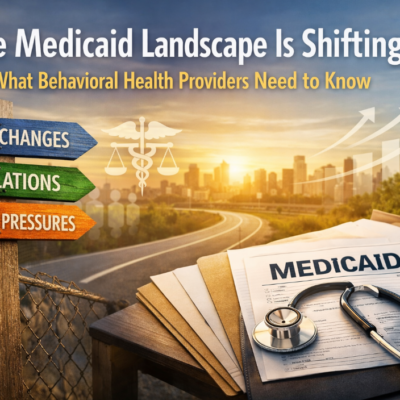
Understanding federal policy changes and their implications for access, enrollment, and care delivery
Medicaid policy underwent significant transformation in 2025, signaling substantial changes ahead for consumers, providers, and state systems. As federal policymakers implemented new Department of Health and Human Services (HHS) directives and enacted provisions within the 2025 Budget Reconciliation Act, Medicaid emerged as one of the most closely watched programs in health care policy (Oss, 2026). These shifts will have direct implications for behavioral health access, enrollment stability, and service continuity—particularly for vulnerable populations.
One of the most consequential developments is the introduction of Medicaid work and community engagement requirements, scheduled to take effect on January 1, 2027. Under these requirements, individuals eligible for Medicaid in expansion states must engage in at least 80 hours per month of employment, volunteer service, or approved education, or attend school at least half time (Oss, 2026). While Congress established several mandatory exemptions—including individuals with substance use disorders (SUD), disabling mental health conditions, pregnant or postpartum individuals, caregivers, veterans with total disability, and former foster youth—concerns remain regarding implementation and oversight.
Stakeholder feedback presented to the Medicaid and CHIP Payment and Access Commission (MACPAC) highlighted significant challenges in verifying compliance with these requirements, particularly for volunteerism and education-related activities. While employment verification may rely on existing data sources, such as Equifax employment records, access to education data and documentation of non-traditional work remains inconsistent across states (MACPAC, 2025). Stakeholders also emphasized the need for clearer federal guidance on qualifying activities, verification standards, and exception criteria.
Beyond work requirements, additional Medicaid policy shifts in 2025 reflected a narrowing of allowable benefits and increased administrative complexity. The Centers for Medicare & Medicaid Services (CMS) rescinded prior guidance supporting coverage of health-related social needs (HRSNs), including housing and nutrition supports, and signaled an end to approvals for certain non-medical benefits under Section 1115 waivers (CMS, 2025). These changes may disproportionately affect individuals with behavioral health conditions, for whom stable housing, nutrition, and community supports are often essential components of recovery.
Federal actions also extended into mental health parity enforcement. In May 2025, HHS, the Department of Labor, and the U.S. Treasury announced they would halt enforcement of newly updated provisions of the Mental Health Parity and Addiction Equity Act (MHPAEA), citing the need for further review (Oss, 2026). This decision introduced additional uncertainty for behavioral health providers navigating coverage standards and reimbursement expectations.
At the state level, Medicaid agencies across the country continued transitioning services into managed care models, particularly for behavioral health and intellectual/developmental disability (I/DD) services. These shifts reflect broader trends toward value-based payment, integrated care models, and increased accountability for outcomes—while also introducing new operational and financial pressures for provider organizations.
As these federal and state policy changes continue to unfold, behavioral health organizations must remain vigilant, informed, and adaptable. For Community Service Boards and other safety-net providers, the coming years will require strategic planning to mitigate enrollment disruptions, support consumer engagement, and advocacy for policies that protect access to essential behavioral health services.
References (APA 7th Edition)
Centers for Medicare & Medicaid Services. (2025). CMS rescinds guidance on Medicaid and CHIP coverage of health-related social needs. U.S. Department of Health and Human Services.
Medicaid and CHIP Payment and Access Commission. (2025). Considerations for implementing community engagement requirements: Findings from stakeholder interviews. MACPAC.
Oss, M. E. (2026, January 8). The Medicaid times are changing: The most read news stories of 2025. OPEN MINDS.