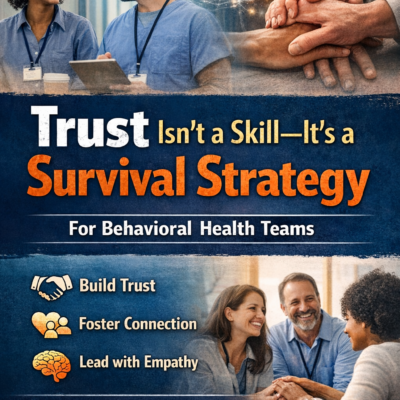
Trust Isn’t a Skill—It’s a Survival Strategy for Behavioral Health Teams
Community Service Board of Middle Georgia (CSBMG)
Introduction
Trust is one of the most frequently referenced concepts in leadership—and one of the most misunderstood. While often presented as a value or expectation, trust is not a static quality that leaders either possess or lack. Instead, it is an evolving process that directly impacts team performance, decision-making, and organizational success.
In behavioral health, where collaboration, communication, and emotional connection are essential, trust is more than a leadership skill—it is a survival strategy. Leaders who intentionally build trust create environments where teams can thrive, and individuals feel safe to engage, communicate, and grow (Goleman, 2025).
Understanding the Foundations of Trust
Trust can be understood through three core components: authenticity, logic, and empathy. Leaders build trust when they demonstrate genuine character, make sound decisions, and show care for others. When one of these elements is missing, trust begins to erode (Goleman, 2025).
This perspective highlights that trust is not fixed—it is fluid and shaped by interactions over time. It requires consistent effort, emotional awareness, and intentional relationship-building.
Trust and Emotional Intelligence
From an emotional intelligence perspective, trust is deeply connected to self-awareness and relationship management. Leaders who understand their own emotional responses—particularly during times of stress—are better equipped to communicate clearly and respond thoughtfully.
Equally important is the ability to build strong relationships. Leaders who actively listen, ask meaningful questions, and demonstrate empathy foster deeper connections with their teams. These behaviors not only strengthen trust but also improve collaboration and decision-making (Goleman, 2025).
The Neuroscience of Trust
Trust is not only a relational concept—it is also biological. When individuals feel trusted and safe, their brains are better able to process information, think creatively, and collaborate effectively.
Conversely, a lack of trust activates stress responses that limit cognitive function. Individuals may become guarded, less communicative, and less engaged. In behavioral health settings, where teamwork and communication are critical, these effects can significantly impact service delivery
Strategies for Building Trust in Leadership
Modern workplaces present unique challenges to building trust. Rapid change, evolving expectations, and the integration of new technologies can create uncertainty among employees.
- Slow Down and Be Present
Trust is built through consistent, meaningful interactions. Leaders who take the time to engage with their teams and recognize relational cues are more likely to foster trust.
- Ask Meaningful Questions
Demonstrating genuine interest in team members’ well-being—beyond task completion—helps build stronger connections. This approach reflects what has been described as “benevolent concern,” emphasizing care for individuals as people, not just employees (Goleman, 2025).
- Practice Transparency
Honest communication is critical, especially during times of uncertainty. Acknowledging both what is known and unknown helps establish credibility and reduces confusion.
- Be Consistent
Trust develops over time through consistent actions. Leaders and team members who follow through on commitments and align their actions with their words reinforce reliability and integrity.
Trust in Behavioral Health Organizations
For CSBMG, trust is foundational to both internal operations and community impact. Trust among staff fosters collaboration and resilience, while trust within the community strengthens engagement and service utilization.
In behavioral health, where individuals often seek support during vulnerable moments, trust is essential to effective care. Leadership and teams that who model trust-building behaviors set the tone for the entire organization.
Conclusion
Trust is not a one-time achievement or a simple leadership skill—it is an ongoing process that requires attention, intention, and consistency. In today’s complex and rapidly changing environment, trust serves as a critical foundation for effective leadership and organizational success.
At CSBMG, prioritizing trust and open communication support not only workforce stability but also the delivery of compassionate, high-quality care. By fostering authenticity, empathy, and consistency, our team can create environments where both staff and communities feel supported, valued, and empowered.
References
Goleman, D. (2025, June 30). Trust isn’t a skill, it’s a survival strategy. Korn Ferry.