
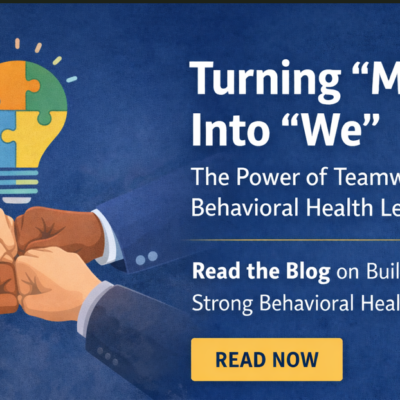
Turning “Me” Into “We”: The Power of Teamwork in Behavioral Health Leadership
Community Service Board of Middle Georgia (CSBMG)
Introduction
Leadership is often described through individual achievements, decision-making, and accountability. However, at its core, leadership is not about one person—it is about the collective strength of a team. As organizations grow and evolve, so does the understanding of what it truly means to work as a team.
In behavioral health, where collaboration directly impacts outcomes, teamwork is not simply a concept—it is a necessity. Effective teamwork transforms individual contributions into collective success, ensuring that organizations can meet the complex needs of the communities they serve (Burnison, n.d.).
Rethinking Teamwork in Today’s Environment
The traditional view of teamwork often paints an overly simplified picture—one rooted in harmony, agreement, and shared success. In reality, modern teams are dynamic, evolving, and sometimes challenging. Roles are expanding, structures are becoming less hierarchical, and leadership is shifting from command-based models to those that inspire and empower (Burnison, n.d.).
In this environment, teamwork requires adaptability, communication, and a shared commitment to a common purpose. For organizations like CSBMG, this means aligning diverse teams across clinical, administrative, and community-based services to achieve unified goals.
Defining What Makes an Effective Team
Research and leadership insights suggest that successful teams share several key principles:
- Start with Purpose
Effective teams begin with a clear understanding of “why” they exist, followed by defining “what” they aim to accomplish and identifying “who” is needed to achieve those goals. This clarity ensures that all team members are aligned and working toward the same mission (Burnison, n.d.).
- Prioritize the Team Over the Individual
While individual contributions are important, effective teams prioritize collective success over personal recognition. When team members focus on shared outcomes, the organization as a whole becomes stronger.
- Embrace Failure as Growth
Failure is not the opposite of success—it is part of the process. Strong teams learn from challenges and use those experiences to improve performance and strengthen resilience.
- Build Trust and Accountability
Trust is the foundation of teamwork. When combined with clear communication, commitment, and accountability, it creates an environment where teams can operate effectively and confidently.
- Turn Conflict Into Innovation
Constructive conflict, when managed appropriately, can lead to better ideas and stronger solutions. Teams that embrace diverse perspectives are better equipped to solve complex problems.
- Align Around Shared Goals
Successful teams ensure that shared interests take priority over individual agendas. This alignment keeps the team focused and moving forward together.
Teamwork Through the Lens of Behavioral Health
In behavioral health organizations like CSBMG, teamwork extends beyond internal collaboration. It includes partnerships with community organizations, law enforcement, schools, and healthcare providers.
Each team member plays a role in delivering coordinated care, whether through crisis response, outpatient services, or community-based programs. When these efforts are aligned, the impact is significantly greater than any single contribution.
Lessons from Rowing: A Model for Team Success
One of the most powerful illustrations of teamwork comes from the sport of rowing. In rowing, success depends on synchronization, trust, and shared effort. Each individual must align their movements with the team to move forward effectively.
This model highlights an important leadership lesson: success is not about being the strongest individual but about contributing to the strength of the team. As one rowing principle suggests, individuals should strive to support the team in a way that enhances overall performance rather than seeking individual recognition (Burnison, n.d.).
This concept is especially relevant in behavioral health, where collaboration and coordination are essential to achieving positive outcomes.
Balancing Effort: The Push and Pull of Teamwork
Effective teamwork requires balance. Just as rowing involves both powerful strokes and controlled recovery, organizations must balance action with reflection.
Leaders and teams must know when to push forward with initiatives and when to step back, reassess, and adjust strategies. This balance allows organizations to remain responsive, resilient, and focused on continuous improvement.
Conclusion
At its core, teamwork is about transformation—turning individual efforts into collective impact. For CSBMG, this means fostering a culture where collaboration, trust, and shared purpose drive success.
In behavioral health, where the work is deeply human and often complex, strong teams are essential. By embracing the principles of effective teamwork, CSBMG can continue to strengthen its services, support its workforce, and improve outcomes for the communities it serves.
Ultimately, leadership is not about “me”—it is about “we.” And it is through that collective strength that meaningful, lasting impact is achieved.
References
Burnison, G. (n.d.). Turning me into we: The power of teamwork in leadership. Korn Ferry.