
Understanding Emerging Healthcare Policy Trends: What It Means for Behavioral Health and Community Care
Community Service Board of Middle Georgia (CSBMG)
Introduction
The healthcare landscape continues to evolve rapidly, with federal and state policy changes shaping how services are delivered, funded, and accessed. Recent updates from national organizations such as the Medicaid and CHIP Payment and Access Commission (MACPAC), the Centers for Medicare & Medicaid Services (CMS), and the U.S. Department of Health and Human Services (HHS) highlight important developments in workforce capacity, telehealth expansion, and care coordination. These changes carry significant implications for behavioral health providers and the communities they serve, including those within the CSBMG network.
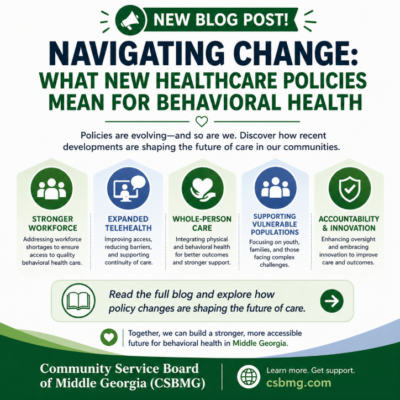
Strengthening the Behavioral Health Workforce
One of the most pressing issues identified in the March 2026 MACPAC report is the ongoing shortage of healthcare professionals, particularly within home and community-based services (HCBS). Policymakers are now encouraging states to report wage data to better understand workforce challenges and improve reimbursement structures. Strengthening the workforce is essential to ensuring access to high-quality behavioral health services, especially in rural and underserved communities (MACPAC, 2026) .
For CSBMG, which serves a diverse 16-county region, workforce sustainability directly impacts the ability to provide timely care, crisis response, and ongoing recovery support.
Telehealth: Expanding Access While Maintaining Balance
Telehealth continues to play a critical role in improving access to care. Recent analyses indicate that nearly one-quarter of Medicaid enrollees have utilized telehealth services, although it accounts for less than 5% of total healthcare spending (MACPAC, 2026) .
Importantly, research from The Commonwealth Fund suggests that telehealth does not increase low-value or unnecessary care. In some cases, it may even reduce it, reinforcing its role as a safe and effective care delivery option. However, policymakers emphasize the importance of maintaining “guardrails” to prevent overutilization while continuing to expand access.
For behavioral health, telehealth offers critical benefits, including:
- Increased access for rural populations
- Reduced transportation barriers
- Greater continuity of care
- Enhanced engagement for individuals hesitant to seek in-person services
Whole-Person Care and Innovation Models
The CMS Innovation Center’s newly announced ASPIRE Model reflects a growing shift toward whole-person care. This model focuses on integrating physical and behavioral health services for children with complex needs, emphasizing early intervention, care coordination, and improved long-term outcomes (CMS, 2026) .
This approach aligns closely with CSBMG’s mission of delivering comprehensive, person-centered care. By addressing both physical and behavioral health needs simultaneously, providers can better support long-term recovery and wellness.
Supporting Vulnerable Populations
Recent policy updates also highlight the importance of serving vulnerable populations, including justice-involved youth and children in foster care. These groups often experience complex behavioral health challenges and face barriers when transitioning between systems of care.
While new federal policies aim to improve continuity of care, implementation challenges remain. Workforce shortages, coordination gaps, and infrastructure limitations—such as limited broadband access—continue to affect service delivery (MACPAC, 2026) .
For community-based providers like CSBMG, collaboration with local partners remains essential to bridging these gaps and ensuring individuals receive consistent, supportive care.
Telehealth Innovation in Preventive Care
Telehealth is also expanding into preventive care through innovative approaches such as telenutrition. HHS highlights programs that connect patients with dietitians virtually, helping manage chronic conditions like diabetes, heart disease, and obesity. These services improve access while promoting long-term health behavior changes (HHS, 2026) .
This trend reinforces the broader role of telehealth—not just as a substitute for in-person care, but as a tool for proactive, ongoing health management.
Increased Federal Oversight and Accountability
The creation of a new Healthcare Task Force by the Federal Trade Commission (FTC) signals increased federal attention to healthcare markets, including telehealth. This initiative aims to address issues related to affordability, competition, and consumer protection (FTC, 2026) .
As telehealth and integrated care models expand, providers must remain attentive to regulatory requirements while continuing to deliver high-quality, ethical care.
Conclusion
The latest healthcare policy developments highlight a system in transition—one that is increasingly focused on access, integration, and accountability. For behavioral health providers like CSBMG, these changes present both opportunities and challenges.
By strengthening the workforce, embracing telehealth responsibly, and prioritizing whole-person care, organizations can continue to meet the evolving needs of their communities. Collaboration, innovation, and a commitment to person-centered care will remain essential as the healthcare landscape continues to shift.
References
Medicaid and CHIP Payment and Access Commission (MACPAC). (2026). Report to Congress on Medicaid and CHIP policy issues.
Centers for Medicare & Medicaid Services (CMS). (2026). ASPIRE Model overview.
U.S. Department of Health and Human Services (HHS). (2026). Telehealth and telenutrition initiatives.
Federal Trade Commission (FTC). (2026). Healthcare Task Force memorandum.
The Commonwealth Fund. (2026). Telehealth and low-value care analysis.