
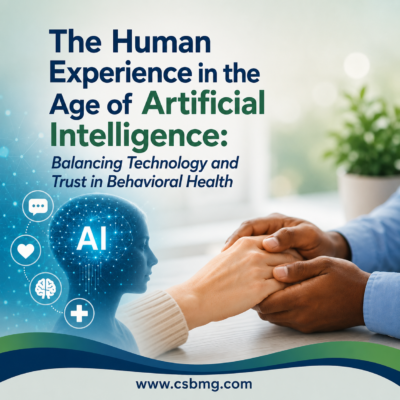
The Human Experience in the Age of Artificial Intelligence: Balancing Technology and Trust in Behavioral Health
Community Service Board of Middle Georgia (CSBMG)
Artificial intelligence (AI) is rapidly transforming how individuals seek health information and engage with healthcare services. From answering everyday health questions to providing guidance on mental health concerns, AI-powered technologies have become an increasingly common resource for consumers. While these innovations offer convenience and accessibility, they also present new opportunities and challenges for behavioral health organizations striving to provide accurate, compassionate, and person-centered care.
The Growing Role of Artificial Intelligence in Healthcare
Recent research indicates that nearly two-thirds (65%) of consumers now use AI tools to address at least some of their healthcare needs. More than half (55%) rely on AI to answer everyday health questions, while 47% use AI for specialized healthcare topics, including behavioral health and dermatology. Additionally, 37% report using AI when faced with urgent health concerns (OPEN MINDS, 2026).
Perhaps even more noteworthy is the rapid increase in adoption. Between 2023 and 2025, AI use for everyday health questions increased by 27%, specialized healthcare inquiries increased by 34%, and urgent healthcare guidance increased by 24% (OPEN MINDS, 2026). These trends demonstrate that consumers are becoming increasingly comfortable integrating technology into their healthcare decision-making process.
Why Consumers Are Turning to AI
Consumers report several reasons for embracing AI-powered healthcare tools. Many appreciate the ability to access information at any time without waiting for appointments or office hours. Others find digital platforms less intimidating than discussing sensitive concerns with another person.
According to OPEN MINDS (2026), among consumers using AI-enabled healthcare tools:
- 55% value their 24/7 availability
- 44% appreciate feeling free from judgment
- 39% believe AI provides greater efficiency
- 32% perceive AI-generated responses as more reliable
These findings suggest that convenience and accessibility are becoming increasingly important factors in how individuals seek healthcare information, particularly regarding behavioral health concerns that may feel difficult or uncomfortable to discuss.
The Challenge of Digital Health Information
While AI can provide helpful educational information, it cannot replace professional medical evaluation, diagnosis, or treatment. One concerning trend identified by OPEN MINDS (2026) is that consumers who frequently rely on digital health tools are also:
- Twice as likely to use online symptom checkers
- More than twice as likely to seek medical information through social media
- More than four times as likely to trust healthcare influencers
- Less likely to consult primary care providers or licensed healthcare professionals for medical guidance
Behavioral health organizations recognize that online information can vary significantly in quality and accuracy. AI-generated responses are only as reliable as the information used to train the technology and may not always reflect an individual’s unique circumstances, medical history, or immediate clinical needs.
What This Means for Behavioral Health Providers
As AI continues to reshape consumer behavior, behavioral health providers have an opportunity to strengthen relationships with the individuals they serve by embracing both innovation and human connection.
Healthcare professionals should routinely ask consumers whether they have researched symptoms or treatment options online or used AI tools before seeking services. These conversations create opportunities to clarify misconceptions, answer questions, and guide individuals toward evidence-based care.
Organizations should also continue expanding their digital presence by providing reliable educational resources through websites, blogs, videos, and social media platforms. As more consumers begin their healthcare journey online, maintaining an informative and trustworthy digital presence helps individuals access credible information before misinformation takes hold.
The Human Experience Still Matters
Although artificial intelligence offers remarkable capabilities, behavioral healthcare remains fundamentally rooted in human relationships. Empathy, trust, compassion, active listening, and individualized care cannot ever be fully replicated by technology.
At Community Service Board of Middle Georgia, we believe technology should enhance—not replace—the therapeutic relationship between consumers and healthcare professionals. AI can serve as a valuable educational tool, but lasting recovery and improved wellness continue to depend on meaningful human connection, clinical expertise, and personalized support.
As technology continues to evolve, behavioral health organizations have an opportunity to combine innovation with compassionate care, ensuring consumers receive both accurate information and the personal support needed to achieve lasting recovery.
References
OPEN MINDS. (2026, June 19). The human experience, or the AI experience? OPEN MINDS Daily Executive Briefing.
OPEN MINDS. (2026). 300,000 voices … and what they tell us about the next era of global change.